
Find Middlesex County Court Records
Middlesex County court records document legal proceedings in Connecticut's central region. The Superior Court in Middletown handles all civil disputes, criminal charges, family law cases, and housing matters for 15 towns across the county. You can search Middlesex County court records online at no cost through the state's case lookup system or visit the courthouse in Middletown to request paper copies of specific files. The Connecticut Judicial Branch operates the court facility and keeps all records under state law. Most court files are open to public inspection, though juvenile cases, certain sealed files, and some criminal records have restricted access as defined by Connecticut statutes.
Middlesex County Court Details
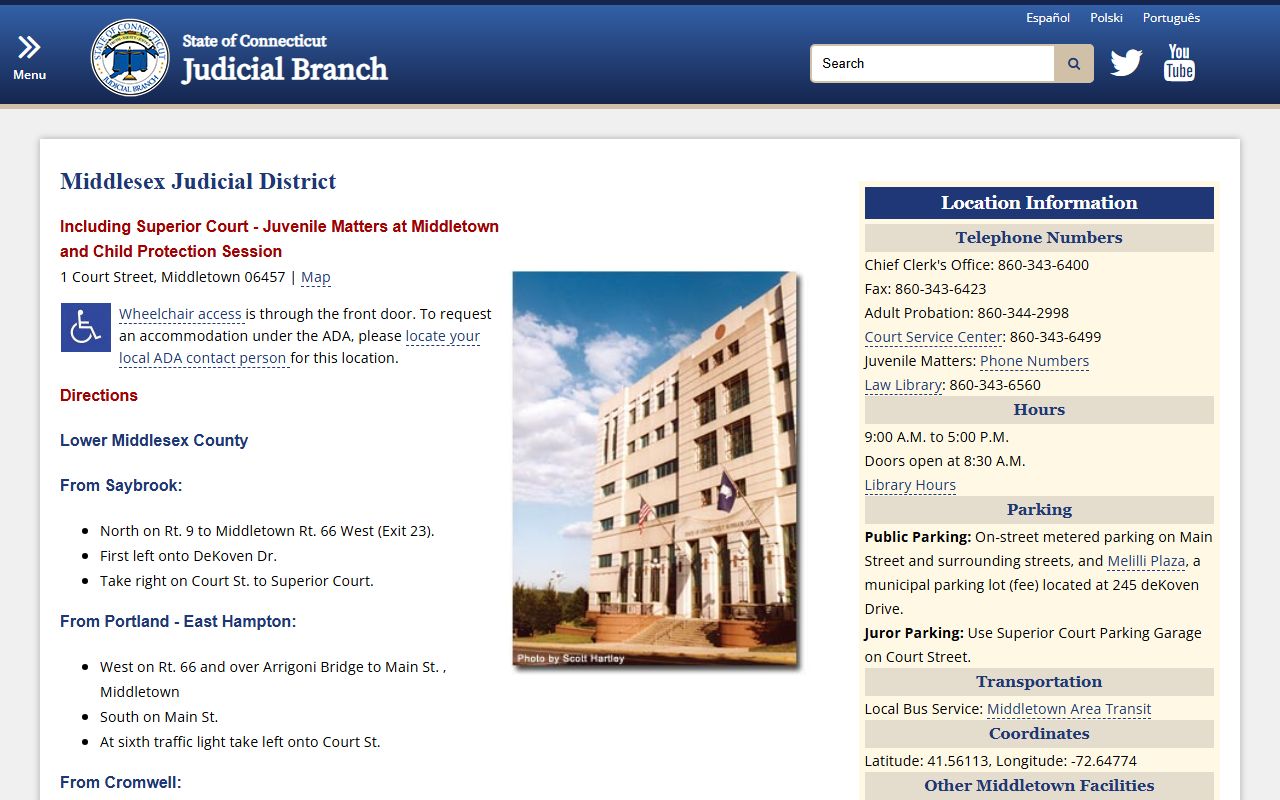
Middlesex County Courthouse
The Middlesex Judicial District serves all towns in Middlesex County from one courthouse at 1 Court Street in Middletown. The clerk's office phone is (860) 343-6400. This is where you file civil lawsuits, divorces, custody cases, and housing matters if you live anywhere in the county. Criminal cases go through the same building but use a different clerk's office and courtrooms.
Towns served include Middletown, Middlefield, Cromwell, Portland, East Hampton, East Haddam, Haddam, Durham, Killingworth, Chester, Deep River, Clinton, Westbrook, Essex, and Old Saybrook. No matter which town you live in, the Middletown courthouse handles your court matters under Connecticut's judicial structure.
Geographical Area No. 9 handles criminal and motor vehicle cases for Middlesex County. This court operates in the same building at 1 Court Street in Middletown. Call (860) 343-6445 to reach the criminal clerk. All arraignments, pre-trial hearings, trials, and sentencing for the county take place here. The criminal court serves the same 15 towns as the civil and family court.
Court staff can help you file new cases or get copies of existing records. Bring a case number if you have one. They can also look up cases by party names. Hours are weekdays during business hours, but call ahead to confirm as court schedules can change.
Online Case Lookup
The Connecticut Judicial Branch runs a free case lookup tool at jud.ct.gov. Use the civil and family link to search for lawsuits, divorces, custody battles, and housing disputes. Enter a last name to start. Add a first name to narrow results. Select Middlesex Judicial District from the court list to see only cases from this county.
Criminal cases use a separate search on the same page. Type in a name or docket number to find criminal and motor vehicle cases. Results show charges, court dates, and current status for Middlesex County criminal court. Click on a case to see the full docket with all events listed by date. You can review what happened at each hearing and what comes next.
The system updates overnight with data from the previous day. If court was held today, the information might not appear until tomorrow. Records go back many years for most case types. Very old cases may not be in the digital system yet. Call the courthouse if you cannot find what you need online. The clerk can check their full records system for you.
Court Record Categories
Civil court files in Middlesex County contain complaints, answers, motions, orders, and judgments. A complaint starts the case and tells what the plaintiff wants. The answer comes from the defendant. Motions ask the judge to make rulings during the case. Orders show what the judge decided. The final judgment closes the case and states the outcome. All these documents become part of the public record at the Middletown courthouse.
Family court records cover divorces, legal separations, custody disputes, child support, and protective orders. These files can be thick with many filings over time as parties work through their issues. Connecticut law allows public access to most family records, but judges can redact parts to protect children or abuse victims as required by state statutes. Entire files can be sealed when needed for safety under Connecticut Practice Book rules.
Criminal records list charges, arraignment dates, plea agreements, trial results, and sentences. The file may also hold pre-trial motions, evidentiary rulings, and appeal notices. Some parts of criminal files are closed to the public. Pre-sentence investigation reports cannot be seen by anyone except the parties and the court as mandated by Connecticut law. Search warrants become public after execution and return per state statute.
Convictions stay public in Middlesex County criminal records. Non-convictions have time limits for public access. Dismissals and acquittals are available for 20 days after the court enters its decision, then the clerk cannot acknowledge the case existed under Connecticut General Statutes Section 54-142a. Nolle prosequi records stay available for 13 months from the date entered. These rules protect people from lasting harm caused by charges that did not stick.
Note: Dockets provide a complete timeline of all events in a case with dates and brief notes about what happened.
Obtaining Record Copies
Go to the clerk's office at 1 Court Street in Middletown to get paper copies. Give them the case number or parties' names. The clerk will pull the file and make copies. Connecticut charges one dollar per page for court record copies. Certified copies may cost more. You might need to show ID before the clerk will release certain case files to you.
For disposed cases no longer kept at the courthouse, email the Centralized Services Unit at SuperiorCourtRecordsCenter@jud.ct.gov. Include the case name and docket number in your request. They retrieve files from central storage and can email small files at no cost or arrange pickup at the Middletown courthouse. Files should be ready in one or two business days according to state procedures.
Mail requests work if you cannot visit in person. Write a letter with the case information and send payment to the clerk's office. Make checks payable to Middlesex Judicial District. Include your return address and phone number in case they need to reach you. Allow extra time for processing and mailing copies back to you. Court staff process mail requests when they have time between in-person customers.
Filing New Court Cases
To start a new case, go to the Middletown courthouse at 1 Court Street. The clerk's office has forms for different case types. Fill them out with all required information. File the original and pay the filing fee. Fees vary based on case type. Small claims cost less than regular civil suits. Ask about fee waivers if you cannot afford the fee. You may need to show proof of income to get a waiver approved.
Many Middlesex County cases now use e-filing. The Connecticut Judicial Branch eServices portal lets you file documents online. You need to register for an account before you can use the system. Once approved, you can submit papers and get court notices electronically. Civil and family cases mostly use e-filing now in Connecticut. Check with the clerk if you are not sure whether your case requires electronic filing.
After filing, you must serve the other parties. A marshal or sheriff can deliver papers for a fee. Certified mail works for some case types. File proof of service with the court to show you followed Connecticut rules. Your case can get dismissed if service is not done right or on time. The clerk can explain service requirements for your case type.
Record Access Provisions
Most Middlesex County court records are public under Connecticut law. Anyone can see them during business hours. You do not have to be a party in the case. You do not need to give a reason for your request. The court must let you inspect public records as mandated by state statutes and the Connecticut Practice Book.
Some records stay confidential. Juvenile cases are sealed under Connecticut General Statutes Section 46b-124. Youthful offender files are closed unless the person is found ineligible for the program per state law. Family cases about abuse or protective orders may hide identifying information to keep protected parties safe. Pre-sentence reports cannot be viewed by the public.
Judges can seal case files in special situations. A party must file a motion asking the court to seal records. The judge holds a hearing and decides if there is good cause to close the file. Sealed records are rare but do happen when sensitive information could harm someone if made public in Connecticut courts. The party seeking to seal records has the burden to show why sealing is necessary.
Finding Legal Help
Statewide Legal Services of Connecticut provides free legal assistance to people with low income. They handle civil matters like housing, family law, and consumer issues. Call them to see if you qualify. Their lawyers can advise you or represent you in court depending on your case and financial situation.
The Connecticut Bar Association runs a lawyer referral service. They match you with a private attorney who handles your type of case. Private lawyers charge fees, so ask about costs before you hire someone. Many offer a first consultation at a reduced rate. Payment plans may be available if you cannot pay the full amount up front.
Court self-help resources are free on the Connecticut Judicial Branch website. Guides and videos explain court processes in plain language. Forms can be downloaded and filled out for common case types. The site has step-by-step instructions for small claims, landlord-tenant matters, and family cases. These materials help people who represent themselves without a lawyer.
Court Services and Programs
The Middlesex courthouse has a family services unit. They help with custody evaluations and family mediation. Mediation lets parties work out agreements without a trial. The mediator does not decide the case but helps people talk through issues and find solutions. Many family cases settle through mediation, saving time and money for everyone involved.
Court transcripts must be ordered through the online transcript system. Attorneys use the eServices portal at jud.ct.gov. Others can fill out a transcript order form and give it to the Court Reporter's Office in Middletown. Transcripts cost money based on how many pages. Regular turnaround takes several weeks. Expedited service costs more but gets you the transcript faster. Ask about fees and timing when you order.
Jury duty notices come from the Middlesex Judicial District office. If you get a notice, you must appear unless you have a valid excuse. The notice explains how to request a postponement or exemption if you qualify. Serving on a jury is a civic duty in Connecticut. Failure to appear can result in fines or other penalties.
Middlesex County Towns
Middlesex County has one town with population over 25,000. Middletown is the county seat with about 48,000 people. Other towns include Clinton, Cromwell, East Hampton, Old Saybrook, Portland, and several smaller communities. Each town has local police records and may have municipal ordinance enforcement through citation hearing procedures as allowed under Connecticut General Statutes Section 7-152c. Town clerks maintain land records, vital statistics, and local ordinances separate from court records.
Adjacent County Courts
Middlesex County borders other Connecticut counties. Hartford County is to the north with courts in Hartford and New Britain. New Haven County sits to the west with judicial districts in New Haven, Waterbury, and Milford. New London County is to the east with courts in New London and Norwich. Cases get filed based on where parties live or where events happened under Connecticut court rules. If your case involves people or property in another county, you may need to use courts there instead of Middlesex.