
Fairfield County Court Records
Fairfield County holds court records for cases filed across Connecticut's most populous county. The Superior Courts in Bridgeport, Stamford, Norwalk, and Danbury handle civil lawsuits, criminal prosecutions, family matters, and housing disputes for residents in towns throughout the county. You can search Fairfield County court records online through the state's free case lookup system or visit any courthouse to request copies of specific files. Most records are public and open to anyone who needs them. The Connecticut Judicial Branch operates all court facilities in the county and maintains records under state law.
Fairfield County Court Information
Fairfield County Superior Courts
Fairfield County divides court services across three judicial districts. The Fairfield Judicial District in Bridgeport serves the central part of the county. The Stamford-Norwalk Judicial District handles cases from the southern coastal region. The Danbury Judicial District covers northern and eastern towns. Each district has a main courthouse with a clerk's office where you can file new cases or get copies of existing court records.
The Fairfield Judicial District courthouse sits at 1061 Main Street in Bridgeport. You can reach the clerk's office at (203) 579-6527. This court serves Bridgeport, Fairfield, Easton, Trumbull, Monroe, and Stratford. Civil cases, family matters, and some criminal cases get heard here. The building also houses administrative offices for the judicial district.
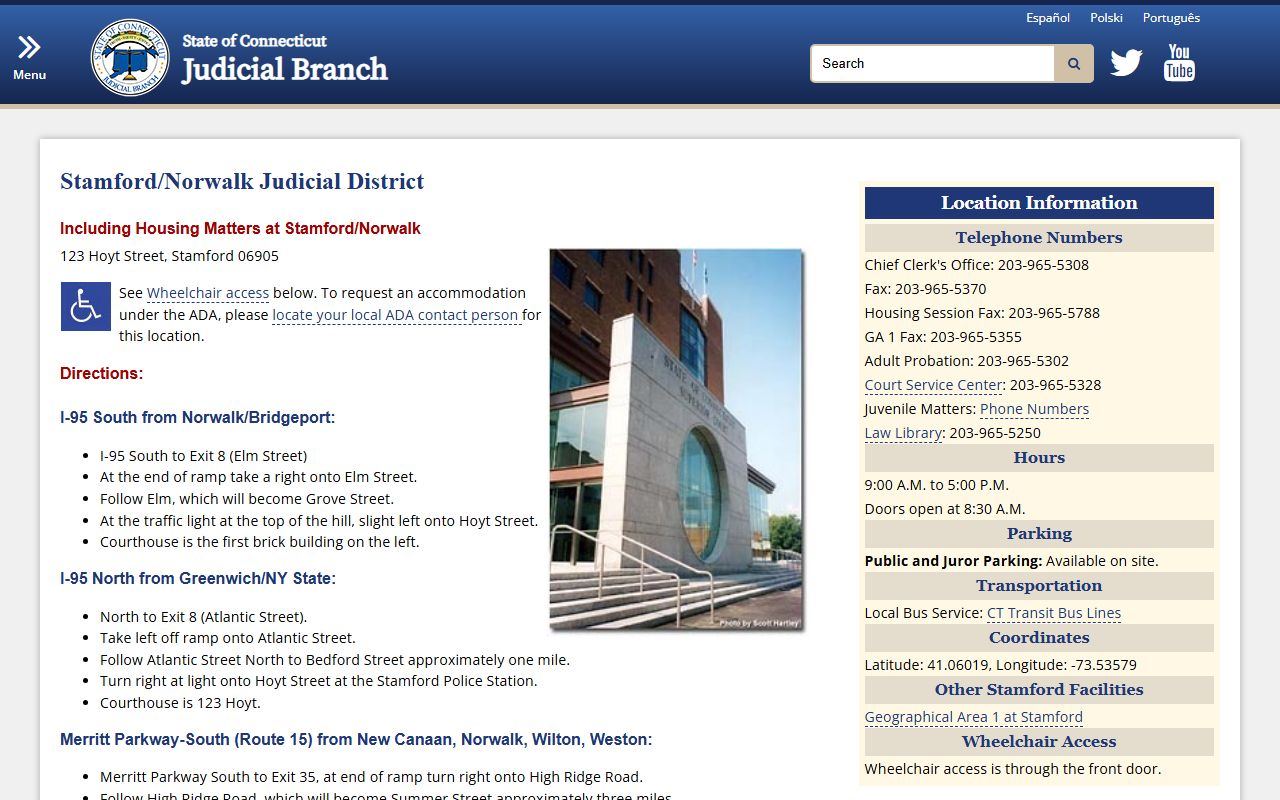
Stamford-Norwalk Judicial District operates from 123 Hoyt Street in Stamford. The clerk's office phone is (203) 965-5308. This district handles court matters for Stamford, Norwalk, Greenwich, Darien, New Canaan, Wilton, Westport, and Weston. Most civil and family cases for these towns go through this courthouse under Connecticut's court structure.
Danbury Judicial District serves the northern part of Fairfield County from 146 White Street in Danbury. Call the clerk at (203) 207-8600 for assistance. Towns in this district include Danbury, Bethel, New Fairfield, Brookfield, Ridgefield, Redding, Sherman, and Newtown. If you live in one of these towns, this is where you file most court cases as required by state rules.
Note: Criminal cases go to geographical area courts that cover specific towns within each judicial district.
Criminal Court Locations
Criminal and motor vehicle cases in Fairfield County get heard at four geographical area courts. These courts handle arraignments, trials, and sentencing for people charged with crimes. Each serves a set list of towns based on where the alleged offense took place.
Geographical Area No. 1 in Stamford covers Darien, Greenwich, and Stamford. The court is at 123 Hoyt Street, and the clerk's number is (203) 965-5208. Area No. 2 in Bridgeport serves Bridgeport, Easton, Fairfield, Monroe, Stratford, and Trumbull from 172 Golden Hill Street. You can call them at (203) 579-6568. Area No. 3 in Danbury handles criminal matters for eight northern towns from 146 White Street. Their phone is (203) 207-8600. Area No. 20 in Norwalk deals with cases from New Canaan, Norwalk, Weston, Westport, and Wilton. That court sits at 17 Belden Avenue in Norwalk, phone (203) 849-3580.
Criminal court records show charges, court dates, plea agreements, and verdicts. These records become public when filed unless sealed by a judge. Some criminal records have limited availability under Connecticut General Statutes Section 54-142a, which governs erasure of non-conviction records after specific time periods pass.
Search Court Records Online
You can look up Fairfield County court records through the Connecticut Judicial Branch website at no cost. The civil and family case lookup covers lawsuits, divorces, custody matters, and housing cases. Enter a last name to start your search. Add a first name if you get too many results. Pick Fairfield Judicial District, Stamford-Norwalk, or Danbury from the court list to narrow your search to this county.
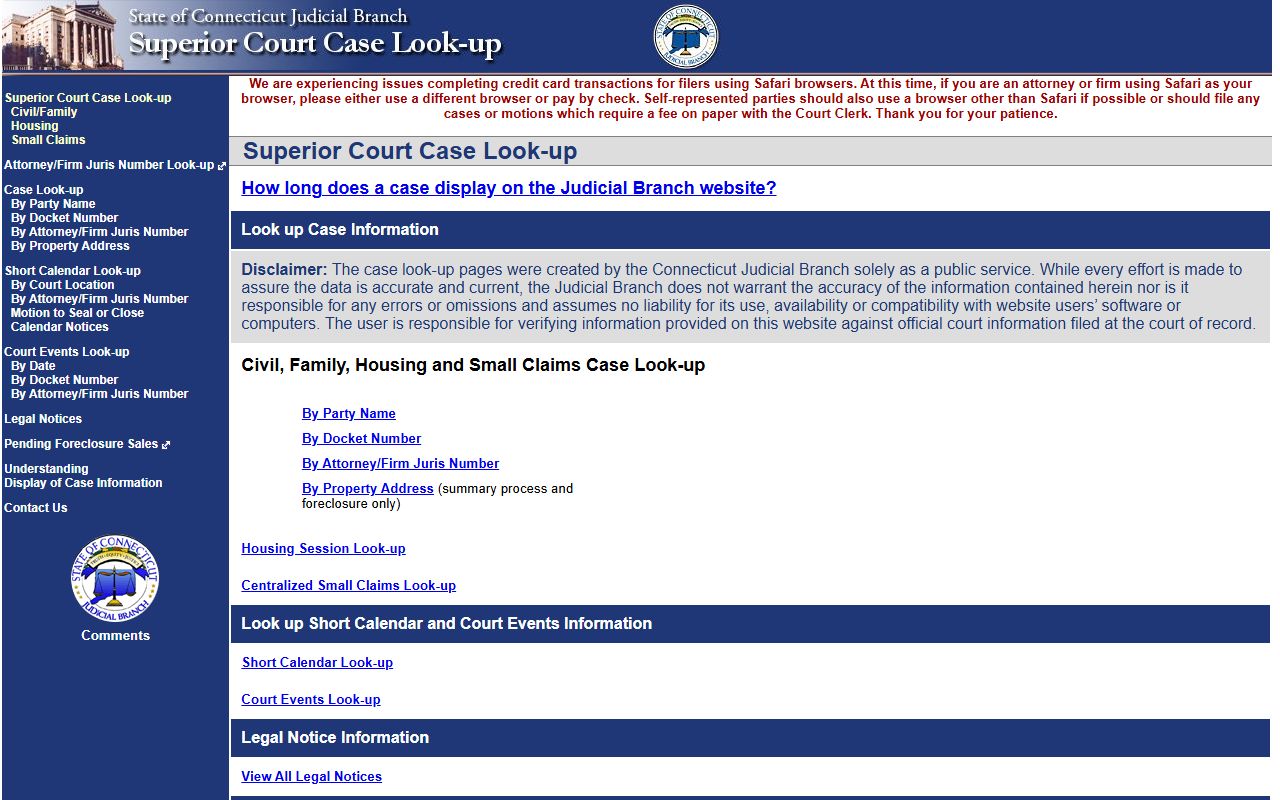
The criminal case lookup works the same way but searches a different database. Type in a name or docket number to find criminal and motor vehicle cases. Results show the charge, court dates, and current status. Click on a case for more detail about what happened at each hearing in Fairfield County courts.
Online records update overnight. If something happened in court today, it may not show up until tomorrow. The system goes back many years for most case types. Very old cases might not be in the digital system yet. Call the court if you cannot find what you need online.
How to Get Copies
Visit the clerk's office at the courthouse where your case was filed to get paper copies. Bring the case number if you have it. The clerk can pull the file and make copies for you. Connecticut charges one dollar per page for court record copies. Certified copies may cost more. You may need to show ID for certain types of cases.
For disposed cases no longer at the courthouse, contact the Centralized Services Unit in Wethersfield. Send an email to SuperiorCourtRecordsCenter@jud.ct.gov with the case name and docket number. They retrieve files from storage and can email small files at no charge or arrange pickup at any Fairfield County courthouse. Files should be ready within one or two business days according to state procedures.
Some Fairfield County courts accept mail requests for copies. Include the case number, parties' names, and payment with your letter. Make checks payable to the judicial district where the case was heard. Allow extra time for mail processing and delivery back to you.
Types of Court Records
Civil court records in Fairfield County include many case types. Contract disputes, personal injury lawsuits, property fights, and debt collection suits all go through Superior Court. Each file has a complaint that starts the case, an answer from the defendant, and a final judgment that ends it. Motions and orders fill out the record as the case moves along. You can see all these papers when you review the file at the courthouse or online if the case was e-filed in Connecticut.
Family court records cover divorces, custody battles, child support, and protective orders. These files can be large with many filings over time. Connecticut law allows public access to most family records, but some parts may be redacted to protect children or abuse victims as set out in state statutes. Judges can seal files in special situations when needed for safety.
Criminal records list the charges, dates of hearings, and final outcomes. Convictions stay public forever. Non-convictions have different rules. Dismissals and acquittals are available for 20 days after disposition, then the record becomes non-disclosable under Connecticut law. Nolle prosequi records stay available for 13 months from the date entered. This comes from Connecticut's erasure statutes that protect people from long-term harm due to charges that did not result in conviction.
Filing Court Cases
To start a new case in Fairfield County, go to the courthouse in the judicial district where you live or where the problem happened. The clerk's office has forms and can tell you which ones you need. Fill out forms carefully with all required information. File the original with the clerk and pay the filing fee. Fees vary by case type. Small claims cost less than regular civil suits. Ask about fee waivers if you cannot afford to pay.
Many Fairfield County cases now use e-filing through the Connecticut Judicial Branch eServices portal. You need to register for an account first. Once approved, you can file documents online and get notices through the system. Not all case types use e-filing yet, but civil and family cases mostly do. Check with the clerk if you are not sure whether your case requires electronic filing.
Service of process is required in most cases. You must deliver copies of your filed papers to the other parties. The marshal or sheriff can serve papers for a fee. You can also use certified mail for some case types. Proof of service must be filed with the court to show you followed the rules in Connecticut.
Legal Help in Fairfield County
Statewide Legal Services of Connecticut offers free legal help to people with low income. They handle civil matters like housing, family law, and consumer issues. Call them to see if you qualify for their services. Their lawyers can give advice or represent you in court depending on the type of case and your situation.
The Connecticut Bar Association runs a lawyer referral program. They match you with a private attorney who handles your type of case. Private lawyers charge fees, so ask about costs before you hire someone. Many offer a first consultation at a reduced rate. Some take payment plans if you need to spread out the cost over time.
Court self-help centers provide resources for people handling cases on their own. The Connecticut Judicial Branch self-help section has guides and videos that explain court processes. These materials cover common issues like small claims, landlord-tenant matters, and family cases. You can find forms and instructions on the Judicial Branch website too.
Courts in Other Counties
Fairfield County borders several other Connecticut counties. If your case involves people or property in those areas, you may need to use courts there. New Haven County sits to the east and has courts in New Haven, Waterbury, and Milford. Litchfield County is to the north with its main courthouse in Litchfield and a criminal court in Torrington. Cases get filed based on where parties live or where events took place under Connecticut court rules.
Major Cities in Fairfield County
Several large cities in Fairfield County have their own court resources. Bridgeport is the county seat and largest city with about 151,000 people. Stamford has close to 139,000 residents. Norwalk is home to over 93,000 people. Danbury serves as a regional hub with about 88,000 residents. Other qualifying cities include Fairfield, Greenwich, Stratford, Newtown, Trumbull, Westport, and Ridgefield. Each city has local police records and may have municipal ordinance enforcement through citation hearing officers as allowed under Connecticut General Statutes Section 7-152c.